Path Separators: A Tale of Two Slashes
In the world of computing, even the smallest details can have a rich and complex history. One such detail is the humble path separator - the character used to denote directory hierarchies in file systems. We'll explore the origins and evolution of path separators, focusing on the two most common characters: the forward slash (/) and the backslash (\).
The story of the forward slash as a path separator begins with the development of UNIX in the late 1960s and early 1970s. However, to truly understand its origins, we need to look even further back.
The story of the forward slash as a path separator begins with the development of UNIX in the late 1960s and early 1970s. However, to truly understand its origins, we need to look even further back.

An epic showdown between Forward Slash and Backslash
The use of the forward slash in file paths can be traced to the MULTICS (Multiplexed Information and Computing Service) operating system, developed in the mid-1960s. MULTICS introduced many concepts that would later influence UNIX, including the hierarchical file system and the use of the forward slash as a path separator.
When Ken Thompson and Dennis Ritchie began work on UNIX (initially called UNICS - Uniplexed Information and Computing Service), they carried over many ideas from MULTICS, including the use of the forward slash. In early UNIX systems, storage media was relatively small, and each directory in the root typically represented a mounted storage device (e.g., /bin, /lib, etc.).
The choice of the forward slash made sense for several reasons:
- It was already familiar to users coming from MULTICS.
- It was easily typed on standard keyboards.
- It visually represented the idea of separating or "cutting" between directory levels.

The Backslash Emerges: MS-DOS and Early Microsoft Systems
The story takes an interesting turn with the development of MS-DOS by Microsoft. When MS-DOS 1.0 was released in 1981, it didn't actually support directories at all. It was essentially a quick rebrand of 86-DOS (also known as Q-DOS), which itself was heavily influenced by CP/M (Control Program for Microcomputers).
From CP/M, MS-DOS inherited the concept of drive letters (A:, C:, etc.), which would become a defining characteristic of Microsoft file systems for decades to come. In MS-DOS 1.0, the forward slash (/) was already being used for command-line options and switches (e.g., program /a /b).
When Microsoft decided to add directory support in later versions of MS-DOS (starting with version 2.0 in 1983), they faced a dilemma. The forward slash was already in use, so they needed an alternative. Their solution was to use the backslash (\) as the directory separator.
This choice had several implications:
- It maintained backwards compatibility with existing MS-DOS programs that used forward slashes for options.
- It visually resembled the forward slash, suggesting a similar separating function.
- It created a distinct identity for Microsoft's file system notation.
The Legacy and Modern Implications
The split between forward slash and backslash usage has persisted to this day, creating one of the most visible differences between Unix-like systems (including Linux and macOS) and Windows systems.
This historical quirk has led to numerous challenges and considerations in software development:
- Cross-platform compatibility: Developers often need to write code that can handle both types of separators.
- Web addresses: The forward slash became standard in URLs, creating a disconnect with Windows file paths.
- Escaping in strings: The backslash is commonly used as an escape character, making Windows paths trickier to handle in some programming contexts.
Many modern programming languages and frameworks now include functions to handle path separators automatically, abstracting away the differences between operating systems.
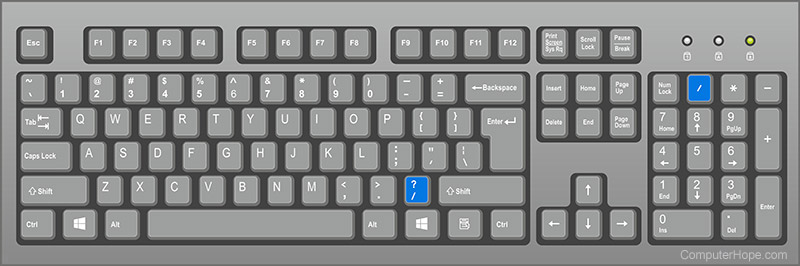
Forward slash key on a keyboard, commonly used in web addresses and Unix-like systems
Which is "Right"?
From a historical perspective, the forward slash (/) has a stronger claim to being the "correct" path separator. It was used in MULTICS and UNIX before Microsoft implemented directory support in MS-DOS. Additionally, its widespread use in URLs has further cemented its position in the digital world.
However, in practice, both separators are equally valid within their respective ecosystems. The choice between them is less about right or wrong and more about the historical context and design decisions of different operating systems.
Conclusion
The story of path separators is a fascinating example of how early design choices in computing can have long-lasting effects. It's a reminder that the technologies we use every day are often shaped by a complex interplay of historical circumstances, technical constraints, and the need for backwards compatibility.
As we continue to build and use computer systems, it's worth remembering these historical artifacts. They not only help us understand why things are the way they are but also remind us of the importance of design decisions in shaping the future of technology.